

The Very Last Call
Nocturnal Narrator


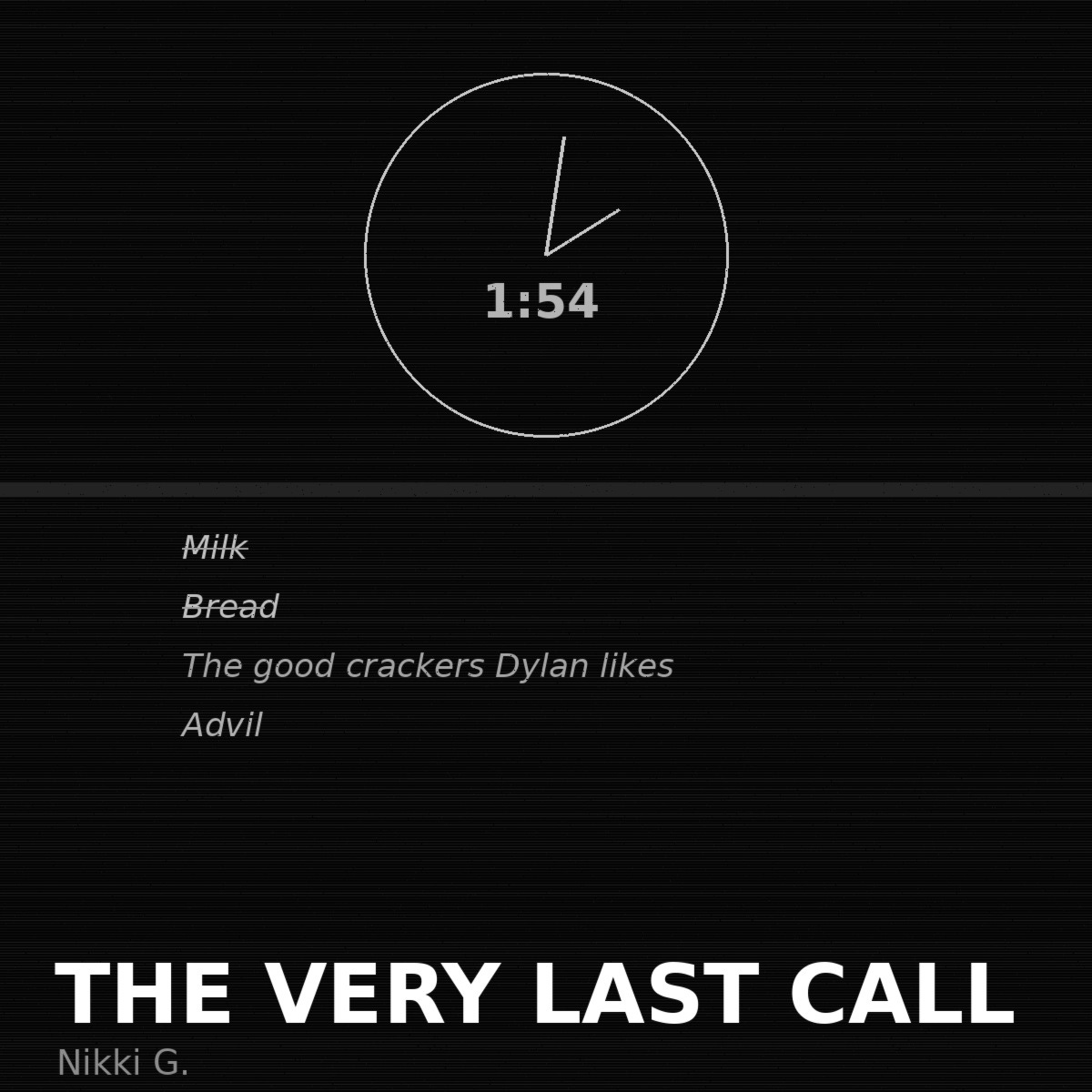
The digital clock behind the bar reads 01:54. It read 01:54 when I picked up this rag, and it will read 01:54 when my fingers rot off the bone. I don’t have a name anymore. I don’t have a face that matters. Just the rag, the glass, and the shift. The bar is always dusty, no matter how much I wipe it down.
Miller had been anchored at the far end of the bar for what felt like a decade. His knuckles were white, hands clamped around a tumbler of whiskey he wasn’t drinking. The ice never melted. The amber liquid never warmed. Every few minutes, his right hand would detach from the glass and blindly grope the empty space to his left, reaching for a bowl of peanuts that wasn’t there.
A bell above the door jingled—a dull, rusted sound—and the air got heavier.
A woman came in. Late thirties, wearing a faded denim jacket over a wrinkled grey t-shirt. She looked like she was still mid-errand, caught in the invisible momentum. She took a seat two stools down from Miller, the vinyl groaning under her weight.
Without looking up, she dropped her car keys on the bar. They hit the wood with a heavy clatter. She reached into her pocket, pulled out a folded slip of paper, and smoothed it flat with her hand. The ink was slightly smudged from the sweat of her palm.
Milk.
Bread.
The good crackers Dylan likes.
Advil.
“What can I get you,” I asked.
She looked up as if she hadn’t realized I was standing there. Her eyes were wide, glassy, still reflecting the glare of headlights she wouldn’t remember for a while.
“I was at the store,” she said, words tumbling out in a rush. “I was just grabbing a few things. The lines were long, and then I was going to—”
She stopped. Her brow furrowed. She looked at the rows of bottles behind me, none of which had labels.
I set a clean glass in front of her. Amber liquid appeared inside, sloshing just the same as if it had been poured.
“My name’s Renee,” she said to the room.
Miller gave a low, wet grunt in response. His eyes slid sideways, catching the edge of her grocery list. “Who’s Dylan?”
Some of the tension bled out of Renee’s shoulders, replaced by the exhaustion of motherhood. “My son. He’s nine. He goes through those crackers like they’re gonna stop making them, it’s ridiculous.”
She laughed. It was small, automatic, and agonizingly warm for a place like this. She picked the list up and folded it again along its original creases, tracing the worn paper.
“His birthday is in three weeks,” she murmured. “I ordered him a skateboard. The specific one he wanted. He’d shown it to me like five times on his iPad so I’d know exactly which one, down to the grip tape. It came in last week.” She looked toward the door, staring at a parking lot she couldn’t see. “It’s still in my car. I hid it in the trunk under a blanket.”
I picked up the rag. I polished the glass I’d just set down. I made notes in my head: Skateboard. Trunk. Three weeks. Nothing that actually mattered anymore.
Outside the frosted window, streetlights flickered, then died completely. Darkness pressed closer to the glass.
“We had a fight this morning,” Renee continued. The warmth was gone. She was talking to the wood. “Stupid stuff. His tablet, homework, chores. I forgot why I was even mad, honestly. By the time I left for the store, I actually felt sick about it. I was going to apologize when I got home.”
She looked at her hands. The cuticles were chewed.
“He’s going to think I was still mad at him. He’s going to wake up tomorrow, and his dad will tell him... whatever his dad tells him. And Dylan will think about the fight. He’s going to carry that morning around like a stone.”
Miller was quiet for a long time. The ice in his glass clinked softly as his hand trembled.
Renee picked up the empty glass in front of her. She held it with both hands, gripping it like a lifeline. “My husband is going to think I got stuck in traffic,” her voice went flat, stripped of inflection. “He’s going to get annoyed first, pacing the kitchen. And then he’s going to get scared. He does everything in that order.”
She pressed her palm flat on the bar, leaving a damp print on the mahogany. “I have to let him know. Someone has to. Is there a phone? Can I call him?”
“Renee,” I said, letting the rag fall still. “You’re on the wrong side of the dirt for a long-distance call.”
She flinched. She picked up her keys. Held them. Squeezed the metal until her knuckles popped. She set them back down.
“He’s going to find the skateboard,” she whispered, a sudden terror blooming in her chest. “They’re going to go through the car. Dylan’s going to be there. He’ll see it still in the box, and he won’t understand.” A ragged exhale tore through her lips.
Miller slowly slid his hand across the bar, stopping an inch away from hers. He thought about it for a long moment.
“He’ll be angry for a while,” he said softly. “And then... he’ll start looking for you in things. In what he likes. In how he thinks. He won’t know that’s what he’s doing. But he’ll find you. Eventually.”
Renee’s eyes filled. A single tear slipped down her cheek, leaving a clean track through the faint layer of soot she hadn’t noticed on her face. She turned her hand over and touched his knuckles with two fingers.
“I have—had—a daughter in Chicago,” Miller said. His voice was hoarse, scraped raw by things unsaid. “She called me every Sunday. Five p.m., like clockwork.”
He stared into his whiskey, watching the amber catch the dead neon light.
“I’d let it go to voicemail more often than not. I wanted to talk to her. God, I did. Every time. But every single Sunday I’d hear that phone ring, and...” He swallowed hard. “I just wanted the drink more.”
“I should’ve called her back,” Miller choked out, the admission breaking something inside him. “My daughter. She would leave a voicemail every time I didn’t pick up. Always started the same—Hi, Dad, it’s me. Thirty years and she still said it like that. Like she was twelve, and still needed me.”
He finally let go of the glass.
“She called last Sunday. I listened to it. I just need someone to know that.” “I’m sure she’s already started looking for you,” Renee said gently.
“I hope not,” Miller replied, his voice hollowing out. “The only place she’ll find me is in the bottom of a bottle.”
I watched them. The brief flicker of connection. The shared gravity of their ghosts. It happens sometimes, before the end. It doesn’t change anything.
“Last call,” I said.
I reached under the counter and grabbed the heavy iron switch.
Miller straightened on his stool, squaring his shoulders. Renee took a breath and set the folded grocery list deliberately on the bar, smoothing it one last time.
I threw the switch.
The dark came for them, absolute and immediate. When the silence settled, and the bar was empty again, I turned to the corkboard on the wall. I picked up a red marker and put an X on the calendar, three weeks from that night.
Happy birthday, Dylan.
I walked over to where Renee had been sitting. I picked up the folded grocery list she left on the wood. I read the smudged ink once more.
I’m also out of bread.
I fucking hate this shift.
Vote for The Very Last Call Here
Nikki G writes dark fiction under the pseudonym Nocturnal Narrator. Nikki is a night owl with a pathological attraction to things that go bump in the night. She likes her fiction like she likes her coffee: dark, bitter, and probably stolen from a much older man who didn't deserve it anyway.
 | A guest post by
|
I knew something was off about this bar immediately but your words hooked me and I had to finish. This was great. Sad but lovely. Thank you for writing it.
This one gave me chills!